

About this KNoT
In this workshop, participants will handle rare books on a range of topics from the ANU Library’s rare book collection. By considering the books as objects, participants will learn to identify and interpret signs of ownership and use that can shed light on individuals’ experiences, the transfer of knowledge within and across societies, and the history of ideas.
The workshop will be divided into three parts, including a demonstration of object analysis and how to separate the acts of observation and interpretation to understand each process more clearly, group-based guided observation and information sharing, and finally, time spent one-on-one with a rare book discovering its individual story.Preparation
What You’ll Learn
- Be able to identify the difference between observation and interpretation and begin to be able to perform each activity independently
- Develop deep observation skills to support capacity for evidence-based problem solving and critical thinking
- Practice evidence-based argumentation and communication skills, both written and verbal, in collaborative and individual contexts
- Learn about the history of books and begin to understand how the book’s form can shape our ways of thinking and engaging with ideas
Learning Resources
- ‘Material and digital traces in patterns of nature: early modern botany books and seventeenth-century needlework’ (2022) by Mary Learner in Intermediate Horizons: book history and digital humanities edited by Mark Vareschi and Heather Macha, 61 - 87: Mary Learner's chapter in Intermediate Horizons: Book History and Digital Humanities (ANU Library)
- ‘Introduction’ (pages 13 – 29) in Boxes and books in Early Modern England: materiality, metaphor, containment (2021) by Lucy Razzall: 'Introduction', Boxes and Books in Early Modern England (ANU Library)
- ‘Do women have a book history?’ (2014) by Michelle Levy in Studies in romanticism, Vol 53 (3), 297 – 317: 'Do women have a book history?' by Michelle Levy (ANU Library)
- ‘What is the history of books’ (1982) by Robert Darnton in Daedalus, 111 (3), 65 – 83: Human Verification
How to Complete This KNoT
Submit your Completion Task here:
Submit your completion task for this KNoT via the Qualtrics survey (ANU Login required). You have 10 calendar days after the KNoT to submit it.
Writing your reflection
Most completion tasks ask you to reflect on what you did. For prompts, sentence starters, and the five areas a strong reflection covers, see Writing Your Reflection. Your completed tasks come together at the end of the semester in the Completion Evidence.
Past dates (1)
You might also like…

Reflexivity as a Learning Tool
Mon 28-Sep 1:00PM to 4:00PM
Throughout the SoCIETIE curriculum you make choices about projects, partnerships, opportunities and learning experiences. But what shapes those choices? Why do different people...
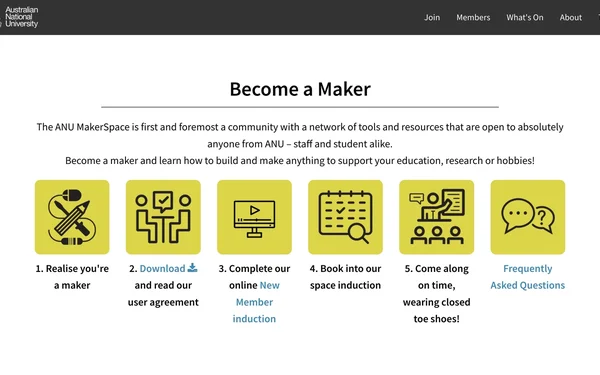
Become a Maker
The ANU MakerSpace was founded on the principle that “doing is a different way of thinking.” This KNoT invites you to test that claim with...